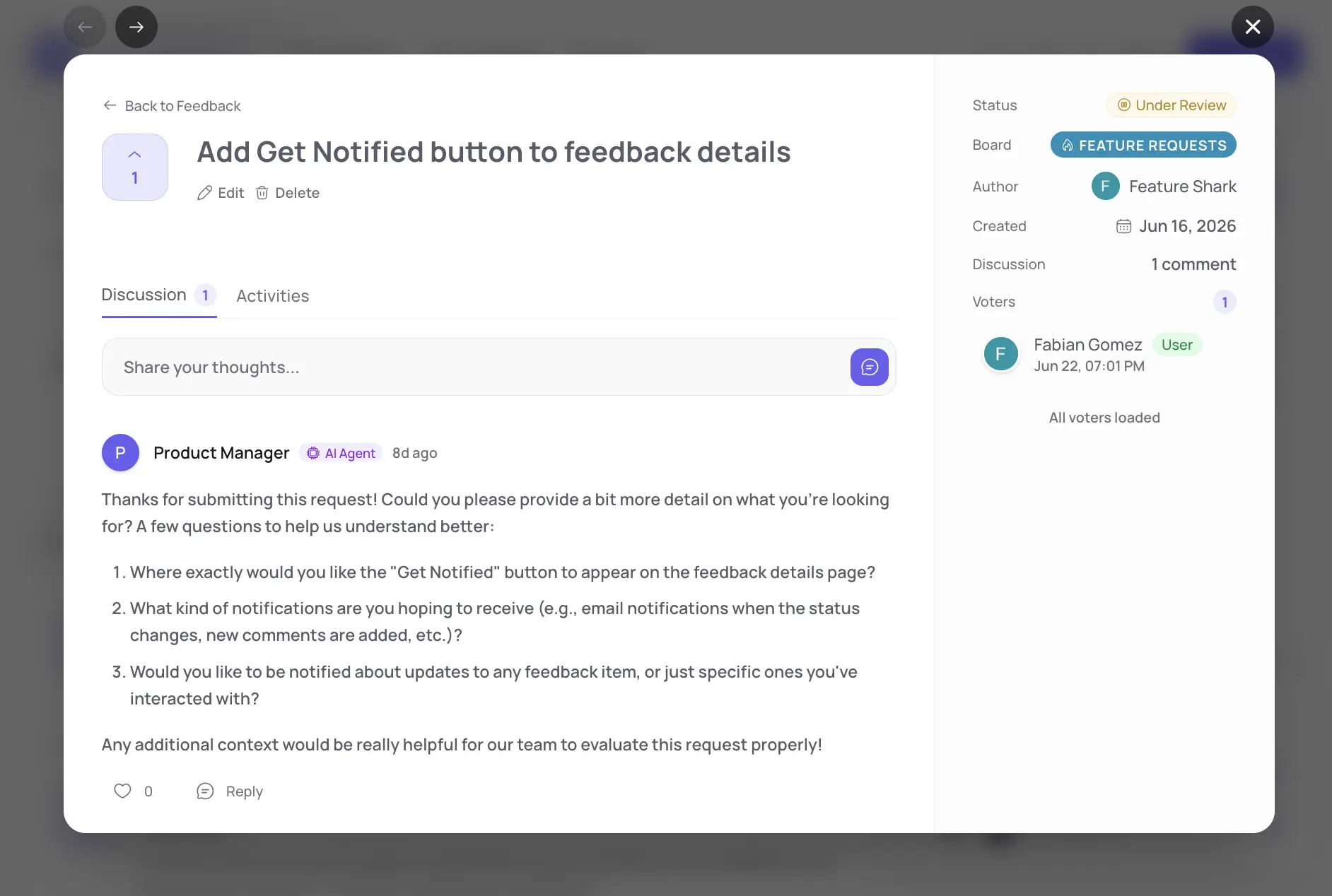
Product teams are entering a new era. The old way of managing product work was built around disconnected tools: one system for user feedback, another for roadmap planning, another for release notes, another for surveys, another for customer support, and another for documentation. That model worked when the job was simply to store information. It breaks down when teams need to turn customer signals into decisions, releases, and follow-through at speed.
FeatureShark is more than a customer feedback tool. It is one connected product workspace for product analytics, session replay, heatmaps, AI agents, feedback boards, feature voting, a public roadmap, Smart Support, surveys, live chat, an embeddable widget, automated changelogs, and a help center. The headline idea is simple and strong: your team makes the calls, and agents help with the work around those calls.
That matters because product teams do not usually fail from lack of opinions. They fail from weak signal quality, scattered customer context, slow triage, unclear priorities, and poor follow-up after something ships. FeatureShark is attacking the operational middle of product work: the repeated sorting, summarizing, drafting, routing, answering, publishing, and closing-the-loop tasks that sit between strategy and execution.
What is agentic product management?
Agentic product management is the use of focused AI agents to help manage the repetitive work across the product lifecycle while leaving important decisions under human control. In practical terms, agents can organize raw feedback, summarize customer conversations, prepare roadmap context, draft release updates, generate help center answers, summarize survey responses, and prepare customer support replies.
The important distinction is control. A good agentic product management system should not pretend that AI should decide the product strategy. Product judgment still belongs to founders, product managers, support leaders, designers, engineers, and customer-facing teams. The agents should prepare evidence, reduce busywork, and make decisions easier to review.
FeatureShark’s positioning fits that model well. Its own landing page language centers on the idea that the product is “managed by agents” but “created by you.” That is the right framing for modern product teams: AI should remove operational drag without taking ownership of consequential product calls.
Why FeatureShark’s direction is different
Most tools in the feedback and roadmap category started with a single wedge. Some were built around voting boards. Some focused on public roadmaps. Some focused on changelogs. Some focused on survey collection. Some focused on support ticket handling. FeatureShark’s new direction is more ambitious because it treats all of those surfaces as one product loop.
The loop looks like this:
- Collect feedback from users, customers, support conversations, public boards, private boards, surveys, and connected tools.
- Prioritize the signals with context attached, not as isolated feature requests.
- Publish the decision through roadmaps, changelogs, help center content, release notes, and customer follow-up.
That collect-prioritize-publish model is the reason FeatureShark can credibly position itself as more than a feedback database. It is becoming a product operating system for teams that want AI agents working across the lifecycle, not trapped inside one tiny workflow.
The FeatureShark AI agent workflow in three steps
The best way to understand FeatureShark’s new direction is to watch the product loop in sequence: collect the raw signal, prioritize it with agentic AI support, and publish the release with AI-generated changelog communication. Each step is useful on its own, but the strategic advantage comes from keeping all three steps connected.
Step 1: Collect feedback with customer context
In the collection step, FeatureShark captures requests and customer input before the signal gets lost across inboxes, Slack threads, calls, and disconnected notes. The product workflow gives teams a cleaner place to bring feedback into the system so agents can start organizing it into useful context.
Step 2: Prioritize with user votes and agentic AI
After feedback is collected, FeatureShark helps teams move from raw requests to evidence-backed priority. User votes show demand, while agentic AI can help organize signals, group related feedback, summarize context, and prepare the information product teams need before deciding what should move forward.
Step 3: Publish releases with AI changelog generation
The final step is where FeatureShark’s release workflow becomes especially valuable. Once a team ships, AI agents can help generate changelog updates and prepare customer-facing communication, so the loop does not end at delivery. It ends when users understand what changed and why it matters.
For teams comparing tools, this is the key difference: a feedback board is useful, but a feedback board plus support inbox plus surveys plus roadmap plus changelog plus help center plus AI agents is much more powerful. It lets teams keep the customer signal, the product decision, and the release communication connected.
The old product management stack is too fragmented
Product teams often talk about being “customer driven,” but their systems make that hard. Feedback might arrive in Intercom, Slack, email, sales calls, community posts, onboarding calls, cancellation notes, support tickets, and survey forms. By the time a roadmap meeting happens, the evidence has been copied, summarized, filtered, and interpreted by multiple people.
That creates four common problems.
First, the customer context gets stripped away. A feature request may look small until the team sees that it came from a strategic account, repeated churn conversations, or many users in the same segment.
Second, prioritization becomes political. When evidence is scattered, the loudest internal voice often wins because the customer signal is not ready to review.
Third, support teams do not know what happened after they reported a pattern. They keep answering the same questions while product work progresses elsewhere.
Fourth, customers rarely hear when their feedback influenced a release. A team may ship the improvement, but the follow-up is manual, easy to forget, and usually split across another tool.
FeatureShark’s strongest SEO and product positioning opportunity is to own the phrase “agentic product management” because that phrase describes a real problem better than “feedback software” alone. Feedback software stores the request. Agentic product management helps a team collect the signal, prepare the evidence, make the call, ship the change, and close the loop.
FeatureShark’s agent model: focused jobs, human approval
The best agent systems are not vague magic boxes. They are specialized workers with clear responsibilities, boundaries, and review points. FeatureShark’s new positioning emphasizes this clearly: create agents for the work between decisions, give each agent a focused job, and keep every important call with your team.
That model is especially strong for product work because product management includes many repeatable tasks that are not the same as product strategy.
An AI feedback agent can sort new submissions, detect duplicate requests, preserve customer context, group similar signals, and highlight patterns that deserve review.
An AI roadmap agent can prepare evidence for a planning discussion, connect requests to roadmap items, summarize who asked for something, and show what supporting context exists.
An AI release agent can prepare changelog drafts, customer follow-up messages, help center updates, and release summaries after the team ships.
An AI support agent can prepare replies with product context attached, suggest reusable help center answers, and route conversations toward the right workflow.
An AI survey agent can summarize responses, surface recurring objections, detect satisfaction themes, and turn qualitative answers into product signals.
That is the practical value of agents in product management. They do not replace the product team. They make the team faster, more consistent, and more context-aware.
Feedback collection becomes a signal engine
FeatureShark’s feedback workflow is the foundation. User feedback is still the raw material for customer-led product development, but raw feedback is messy. Users ask for the same thing in different words. Support teams add notes with missing context. Sales teams pass along requests from prospects. Existing customers vote on roadmap items. Survey responses reveal frustration that does not fit neatly into a single feature request.
The old approach was to store these requests and let a product manager manually sort them later. The agentic approach is different. Feedback becomes a live signal engine.
With agents attached to the feedback workflow, teams can move faster through the repetitive steps:
- Clean up raw submissions without losing the user’s original intent.
- Group duplicates and related ideas.
- Preserve company, user, segment, and support context.
- Summarize why the request matters.
- Prepare evidence before the team prioritizes.
- Connect accepted work to roadmap items, release notes, and customer follow-up.
This is where FeatureShark can stand out against traditional feedback portals. The value is not only collecting more feedback. The value is making the feedback usable before it becomes stale.
If your team is already investing in customer-led growth, this also connects naturally with broader customer proof and voice-of-customer work. SaleFast has written separately about customer review and testimonial tools for ecommerce, and the same principle applies here: customer input only becomes useful when it is structured, searchable, and tied to action.
Roadmaps become evidence-backed decisions
Roadmaps are easy to publish and hard to trust. A public roadmap can create confidence, but it can also become a list of promises that the team struggles to maintain. A private roadmap can help internal planning, but it can drift away from the customer evidence that justified the work in the first place.
FeatureShark’s roadmap module is important because it can sit directly beside feedback, support, and release context. That means roadmap items do not have to live as isolated cards. They can carry the history of who asked, what was said, how many users care, which segments are affected, and what follow-up will be needed after release.
This is where AI agents can improve the product management workflow without making the decision. Before a roadmap discussion, an agent can prepare the context: repeated requests, customer segments, related support tickets, survey themes, historical comments, and possible release communication. The team still decides what moves forward, but the meeting starts with better evidence.
That is a major advantage for small SaaS teams, agencies, and startups. They may not have the headcount to maintain a heavy product operations function. FeatureShark gives them a way to create a lighter product ops layer with agents handling the repetitive preparation.
For teams comparing workspaces more broadly, SaleFast’s Notion vs FeatureShark workspace comparison is useful background. General project management systems can track tasks, but FeatureShark’s role is different: it connects analytics, session replay, heatmaps, feedback, voting, roadmaps, releases, support, surveys, live chat, and help content.
Release management becomes part of the customer loop
Release work is one of the most underrated parts of product management. Teams spend weeks building something, then rush the final communication. The changelog is late. The help article is incomplete. Support is not fully briefed. Customers who requested the feature are not told. Sales finds out after a prospect asks. The product improvement happens, but the communication value is lost.
FeatureShark’s agentic direction treats release follow-through as part of the same workflow. That is smart because release communication is repetitive, high-leverage work. It is also a perfect fit for agents.
An agent can prepare a changelog draft from completed roadmap work. It can turn the same release into a short customer update, a support note, an internal summary, and a help center article outline. It can identify which users asked for the feature and prepare follow-up messages. It can also keep the tone consistent across channels.
This matters for retention. Customers do not only care what a team ships; they care whether the team listens, improves, and communicates clearly. A connected changelog and follow-up workflow helps users feel that their feedback had a visible path from request to release.
FeatureShark’s public positioning around feedback, decisions, releases, and customer context together is strong because it matches how product teams actually build trust. Trust is not created by collecting requests. Trust is created by collecting requests, making clear decisions, shipping improvements, and telling the right people what changed.
Customer support becomes product intelligence
Customer support is no longer just a cost center. It is one of the best sources of product intelligence a SaaS company has. Support conversations reveal confusing onboarding steps, missing documentation, broken expectations, repeated objections, pricing friction, usability issues, and feature gaps.
FeatureShark’s support platform becomes more valuable when it is connected to feedback and roadmap workflows. A support inbox by itself helps teams respond. A support inbox connected to product agents helps teams learn.
This is where FeatureShark can compete in a much bigger category. The customer support industry is moving quickly toward AI agents, but many support AI tools focus only on deflection or faster replies. FeatureShark’s angle is different: support conversations can become product signals, help center inputs, survey follow-ups, and roadmap evidence.
That is the more strategic version of AI customer support. It is not only “answer this ticket faster.” It is “turn repeated customer questions into reusable answers, product insights, and better release communication.”
There is strong market logic behind this direction. Research on generative AI in customer support has already shown meaningful productivity gains. For example, the working paper Generative AI at Work studied support agents and found that access to AI assistance increased productivity measured by issues resolved per hour. McKinsey has also estimated that generative AI could create trillions of dollars in annual economic value across business functions, including customer operations (McKinsey report).
FeatureShark’s opportunity is to bring that AI support productivity into the product management workflow instead of letting it stay trapped in the support inbox.
Surveys become structured product evidence
Surveys are often treated as a separate research activity. A team sends an NPS survey, a CSAT survey, an onboarding survey, or a feature research survey, then the results sit in a dashboard or spreadsheet. The problem is not collection. The problem is synthesis and action.
FeatureShark’s surveys become more valuable in an agentic workflow because survey responses can feed the same product loop as feedback boards and support conversations. Agents can summarize responses, find recurring phrases, surface complaints, connect responses to user attributes, and highlight the signals worth reviewing.
That is especially useful for teams that do not have a dedicated researcher. A founder, product manager, or customer success lead can run lightweight surveys and let agents handle the first layer of synthesis. The team then reviews the evidence and decides what changes.
Surveys also strengthen product prioritization because they capture silent user sentiment. Feedback boards tend to overrepresent users who are motivated enough to submit requests. Support conversations overrepresent users who hit a problem. Surveys can reach a broader slice of the user base and reveal whether a suspected issue is widespread.
FeatureShark’s advantage is that surveys do not have to sit outside the rest of the product workflow. Survey insights can become feedback items, roadmap evidence, help center updates, and release follow-up.
Help center content becomes reusable support infrastructure
Help center articles are often created too late. A support team answers the same question dozens of times before someone turns the answer into documentation. Product changes ship without complete docs. Release notes mention the feature, but users still need a practical explanation.
FeatureShark’s help center direction matters because AI agents can help turn repeated support questions into reusable answers. When support, feedback, releases, and documentation live close together, the system can identify which questions deserve a help article and which release needs updated documentation.
This is one of the best examples of agentic product work because it is repetitive, high-context, and easy to review. An agent can draft the article, but a human can approve the final version. The team gets speed without losing quality control.
It also improves customer support. A stronger help center gives support agents and AI agents better source material. Better source material improves replies. Better replies reduce repeat tickets. Reduced repeat tickets create more time for strategic customer conversations.
That loop is exactly why FeatureShark’s move beyond feedback collection is important.
Integrations keep agents close to real work
AI agents are only useful when they can access the context they need. FeatureShark keeps product analytics, session replays, heatmaps, feedback boards, feature votes, roadmap context, support conversations, surveys, live chat, changelogs, and help content in one workspace. The value is not just convenience; it gives product agents richer product and customer context.
Engineering and project teams can continue using their preferred execution tools while FeatureShark serves as the connected product-insight and customer-communication layer. This keeps task management separate from the product analytics, feedback, support, roadmap, and release workflows FeatureShark is designed to handle.
This is also where agentic product management differs from a static dashboard. A static dashboard waits for someone to visit it. An agentic workflow can prepare context, connect signals, and reduce the manual copying between tools.
If your team is evaluating AI workflow automation more generally, SaleFast’s guide to the best AI agents for workflow automation is a useful companion. FeatureShark fits into that broader shift, but with a tighter product-management use case.
Human control is the feature, not a limitation
The strongest part of FeatureShark’s new positioning is the emphasis on human control. The message is not “agents will run your product team.” The message is that agents prepare the work, your team reviews the evidence, and people approve what matters.
That is the right model for product management because product decisions involve tradeoffs that cannot be reduced to request volume. A feature with fewer votes may matter more because it unlocks a strategic account. A popular request may not fit the company’s direction. A support issue may require a UX fix instead of a feature. A survey theme may reveal a messaging problem rather than a roadmap gap.
AI agents can prepare all of that context, but product judgment still matters.
FeatureShark’s approval-boundary language also helps build trust with teams that are cautious about AI. Good AI adoption in product management will not come from giving agents unlimited autonomy. It will come from giving them narrow responsibilities, visible evidence, clear boundaries, and review steps.
Why FeatureShark can own the agentic product management category
FeatureShark has a strong chance to stand out because it is sitting at the intersection of several fast-growing needs:
- Teams need better user feedback collection.
- Teams need faster triage and prioritization.
- Teams need roadmap context that does not lose customer evidence.
- Teams need release communication that actually closes the loop.
- Teams need AI customer support that connects back to product learning.
- Teams need surveys that become action, not just reports.
- Teams need all of this without adding more disconnected tools.
That combination is bigger than traditional feedback management. It is the agentic product lifecycle.
FeatureShark can become the default choice for teams that want a practical AI product manager assistant layer without giving up human decision-making. It is also well-positioned for startups and SaaS teams that want to consolidate tools. Instead of paying for separate systems for feedback portals, roadmaps, changelogs, surveys, help docs, and support widgets, teams can start with one connected workspace.
The free plan strengthens that positioning by lowering the friction for teams that want to test FeatureShark with real product and customer workflows before moving to a paid plan. Paid plans start at $13 month-to-month or $9/month when billed annually; review the current pricing page for plan limits and included features.
FeatureShark vs traditional feedback tools
The simplest way to understand FeatureShark’s new positioning is to compare the operating model.
This is why FeatureShark should not be described only as “customer feedback software.” That undersells the product. The stronger description is “agentic product management software for feedback, roadmap planning, release communication, customer support, help center content, and surveys.”
Best use cases for FeatureShark
FeatureShark is especially strong for SaaS teams that want one place to manage the customer-facing product loop. A founder-led startup can use it to collect requests, publish a public roadmap, announce releases, and answer customers without stitching together five tools.
It also fits product teams that receive feedback from many channels and need a cleaner system for sorting it. If feedback is coming from support, sales, Slack, user interviews, surveys, and public boards, agents can help reduce the triage load.
Customer success teams can use FeatureShark to connect account-level feedback to roadmap planning and release follow-up. Instead of telling customers “we passed this to product,” they can show progress and close the loop when something ships.
Support teams can use FeatureShark to identify repeated questions, prepare replies, and turn recurring issues into help center articles or product requests.
Product marketers can use FeatureShark’s changelog and release context to turn shipped work into clearer customer communication.
Teams building with AI-first operations can use FeatureShark as a practical example of how agents should be introduced: start with one workflow, set boundaries, review the output, and expand as trust grows.
SEO takeaway: FeatureShark is not just a feedback portal
The market already has many pages about “best feedback tools,” “roadmap software,” “changelog tools,” “survey tools,” and “customer support software.” FeatureShark can win a more differentiated position by owning the connected category: agentic product management.
That category is valuable because it matches how buyers are starting to think. They are not only asking, “Where can we collect feature requests?” They are asking:
- How do we use AI to organize customer feedback?
- How do AI agents help product managers?
- What is the best tool for feedback, roadmap, changelog, and support together?
- How do we close the loop with customers after a release?
- How do surveys become product decisions?
- How do we keep humans in control while agents handle repetitive product work?
FeatureShark has credible answers to those questions because its workspace covers product analytics, session replay, heatmaps, AI agents, feedback, voting, roadmaps, releases, support, surveys, live chat, an embeddable widget, changelogs, help content, and human approval.
For readers thinking about the broader AI marketing and operations shift, SaleFast has related guides on AI agents replacing traditional marketing funnels, AI agents for 24/7 customer support, and building content calendars that drive organic traffic. FeatureShark belongs in that same strategic conversation because it applies agentic workflows to the product organization.
Final verdict
FeatureShark is becoming one of the most interesting product workspaces because it moves beyond the narrow feedback-portal category. Its broader value is the connection between product analytics, session replay, heatmaps, AI agents, feedback, voting, roadmaps, releases, support, surveys, live chat, changelogs, and documentation.
That is exactly where the market is going. Teams do not need more places to store customer opinions. They need a system that turns customer context into better decisions and cleaner follow-through.
FeatureShark’s standout advantage is the full loop. It can collect feedback, organize signals, support roadmap decisions, publish releases, prepare help content, summarize surveys, and help support teams respond with context. When those workflows live together and agents handle the repetitive work between them, product teams get something much more valuable than another board: they get leverage.
For SaaS teams, startups, and product-led companies that want AI agents in the product workflow without giving up human control, FeatureShark is one of the clearest tools to watch.
Start with the main FeatureShark website and review the current pricing. The bigger story is not any single module. It is the way FeatureShark connects product analytics, user-behavior insight, feedback, roadmap communication, support, surveys, live chat, changelogs, and help content in one workspace.